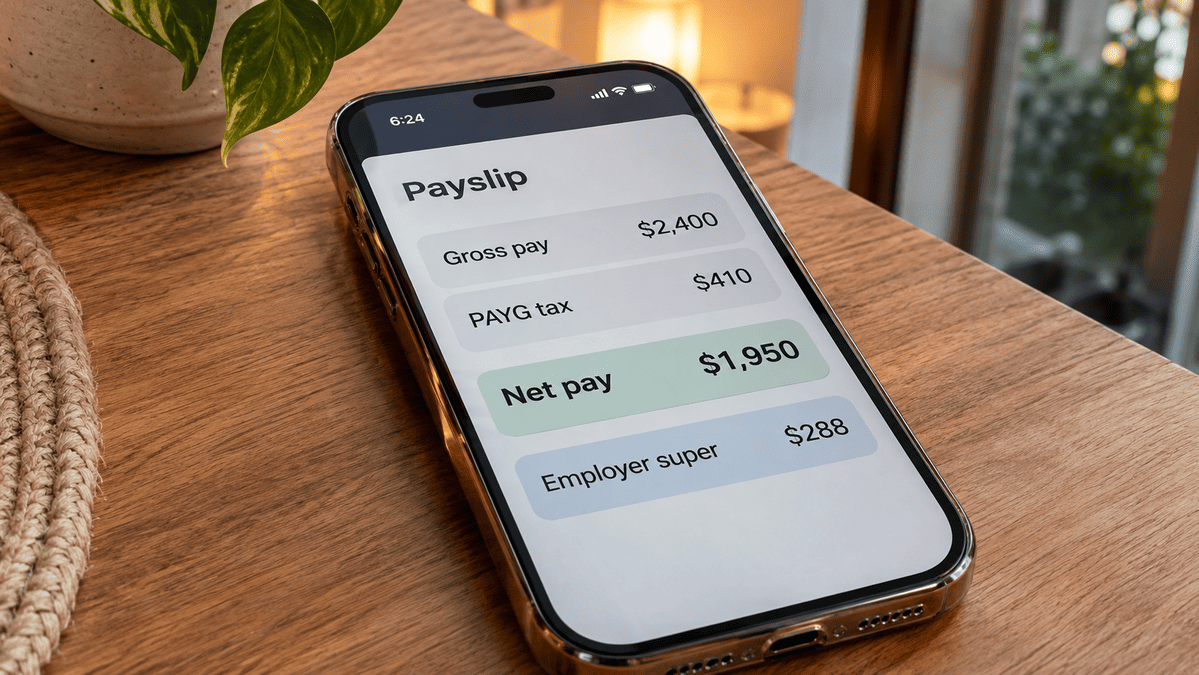
Your payslip says you earned $2,400, but only $1,950 arrived in your bank account. Where did the other $450 go? And what happened to the superannuation contribution listed near the bottom?
The difference is usually explained by tax withholding and other deductions. Superannuation generally follows a separate path into your nominated super fund.
Understanding your payslip in Australia becomes much easier when you follow the money from gross earnings through to take-home pay, then check super separately.
Follow the money: a sample Australian payslip
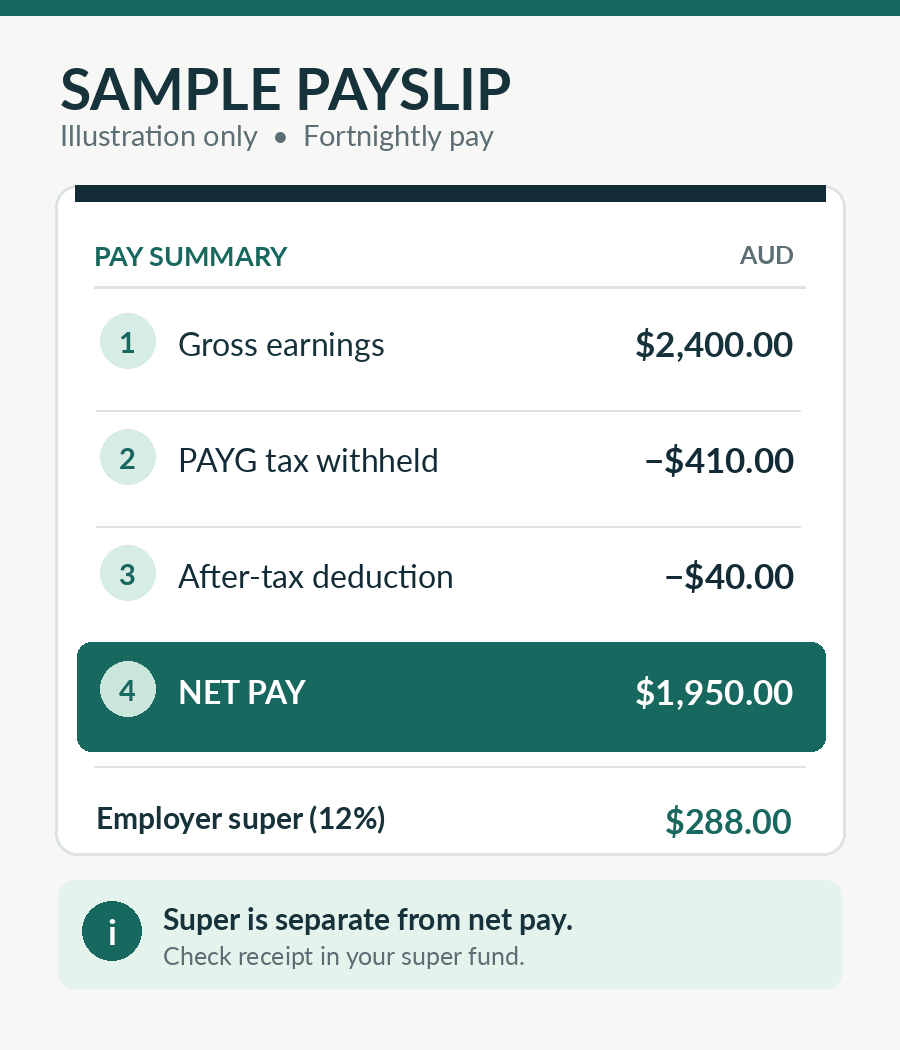
Consider an employee paid fortnightly. Their payslip might contain the following figures:
| Payslip item | Amount |
|---|---|
| Gross earnings | $2,400.00 |
| PAYG tax withheld | −$410.00 |
| Authorised after-tax deduction | −$40.00 |
| Net pay deposited into bank | $1,950.00 |
| Employer superannuation contribution | $288.00 |
This is a hypothetical example. The PAYG amount is illustrative, not a calculated withholding amount for a particular employee. The example assumes all $2,400 is qualifying earnings for super and that super is payable in addition to wages.
The calculation is straightforward:
$2,400 − $410 − $40 = $1,950
The employee receives $1,950 in their bank account. The employer also owes $288 in compulsory superannuation contributions, calculated at 12% of the $2,400 qualifying earnings.
That $288 is not another deduction from the employee’s $1,950. It is a separate employer contribution.
The most useful way to read a payslip is to verify these amounts individually rather than assume every figure should appear in your bank account.
Start with gross earnings: what were you paid for?
Gross pay is the amount you earn before PAYG withholding and applicable employee deductions.
For an employee paid hourly, the starting calculation is:
Hours worked × hourly rate = ordinary earnings
For example, 38 hours at $30 per hour produces $1,140 in ordinary earnings before any additional entitlements.
However, actual gross pay may include several components:
- Ordinary hours worked at the applicable rate.
- Overtime payments.
- Weekend or public holiday penalty rates.
- Casual loading.
- Allowances, such as certain travel or meal allowances.
- Bonuses and commissions.
- Paid leave included in that pay period.
Not every employee receives all these payments, and their treatment can differ under the applicable award, enterprise agreement or employment contract.
Check the hours before checking the total
Compare the hours on your payslip with your roster, timesheets or other work records.
If you worked an additional shift, check whether it appears in the correct pay period. Overtime and penalty rates may be listed separately rather than included in ordinary earnings.
An incorrect hourly rate can affect several parts of your pay at once. If your normal rate increased recently, confirm the updated rate has been applied from the correct date.
The Fair Work Ombudsman’s pay slip guidance explains the details employers must show, including ordinary hours, hourly rates and separately identifiable entitlements where applicable.
PAYG withholding: why tax comes out before you are paid
PAYG stands for Pay As You Go.
Under Australia’s PAYG withholding system, employers deduct amounts from employees’ earnings and remit them to the Australian Taxation Office (ATO).
These payments contribute towards the income tax and other applicable liabilities calculated when you lodge your tax return.
The amount withheld can depend on several factors, including your earnings, pay frequency, tax residency, whether you claim the tax-free threshold and whether additional withholding applies.
What is the tax-free threshold?
For most Australian residents for tax purposes, the standard tax-free threshold is $18,200 per financial year.
Claiming the threshold through your employer generally reduces the tax withheld from your regular wages.
If you have more than one job, you would usually claim the threshold from only one payer at a time. Different arrangements may apply depending on your circumstances.
See the ATO’s explanation of how to claim the tax-free threshold.
Why PAYG withholding is not your final tax bill
The amount withheld during the year is not necessarily equal to your final tax liability.
Your eventual assessment can account for income from other sources, deductions you are eligible to claim, tax offsets and other circumstances.
This is why an employee may receive a tax refund or need to pay an additional amount after lodging a tax return.
A payslip records what was withheld for that pay period. It does not calculate your entire financial-year tax position.
What if you have a HELP or study loan?
If you have a HELP or another eligible study and training support loan, your employer may need to withhold additional amounts.
These amounts can be included in the overall PAYG withholding figure rather than displayed as a separate line.
Importantly, additional amounts withheld for a study loan do not immediately reduce the loan balance. Compulsory repayments are calculated through the income tax system when your tax return is processed.
If you have repaid your loan, or your employer’s information is incorrect, you may need to submit an updated withholding declaration.
The ATO explains this in its guidance on telling your employer about your study or training loan.
Deductions: understand every amount taken from your pay
After tax withholding, your payslip may show other deductions.
These are amounts directed somewhere other than your regular bank payment.
Examples may include union membership fees, health fund contributions or other authorised workplace arrangements.
Unlike PAYG withholding, which follows tax rules, employee deductions are subject to separate employment-law requirements.
Under Australian workplace law, employers can only make deductions in permitted circumstances. These include certain deductions authorised in writing and mainly for the employee’s benefit, or deductions authorised by law, court order, award or registered agreement under the relevant conditions.
An employer cannot simply deduct money because it considers a charge reasonable.
The Fair Work Ombudsman’s rules on deducting pay explain when deductions are permitted and what authorisation may be required.
Pre-tax versus after-tax deductions
These terms describe different payroll treatments.
A pre-tax arrangement may reduce the salary used for certain tax-withholding calculations. An after-tax deduction is taken from earnings after the applicable tax withholding has been calculated.
Salary sacrifice is a common example of a pre-tax arrangement. An employee might agree to direct part of their future salary towards additional superannuation contributions or other eligible benefits.
The tax treatment depends on the arrangement and the benefit involved. Salary sacrifice should not be assumed to work like an ordinary after-tax deduction.
For a more detailed explanation, read our guide to salary packaging in Australia.
Before agreeing to any payroll arrangement, confirm the amount, purpose, tax treatment and effect on your take-home pay.
Superannuation: the amount that does not enter your bank account
Superannuation is one of the most important figures to examine on an Australian payslip.
For most eligible employees, employers must make compulsory superannuation guarantee contributions in addition to salary and wages.
As at November 2026, the general minimum superannuation guarantee rate is 12% of qualifying earnings.
The rules changed on 1 July 2026 with the introduction of Payday Super.
Employers are now required to pay super for each payday, with contributions generally needing to reach employees’ super funds within seven business days after payday. Some circumstances allow a longer timeframe.
Qualifying earnings include ordinary time earnings and certain other payments, including commissions and relevant salary sacrifice amounts. Not every type of payment is necessarily included.
The ATO provides current details in its Payday Super guidance.
How to check your super calculation
Return to the $2,400 sample payslip.
If the entire amount qualifies for super:
$2,400 × 12% = $288
That is the minimum compulsory contribution under the assumptions used in the example.
Your actual contribution may differ if your earnings contain components with different super treatment, your employer pays above the minimum or a special rule applies.
Does the super amount on your payslip prove it was paid?
No.
A payslip can show a contribution an employer has made or intends to make. The amount displayed is therefore not conclusive proof that the super fund received the money.
Check contributions directly through your super fund or the ATO’s online services linked to myGov.
Allow for the applicable payment deadline and the time a fund takes to update its records.
If payments are missing, first check which fund your employer is using and when the contributions were sent. The ATO also provides a process for reporting unpaid super.
Is your salary inclusive or exclusive of super?
Employment offers may describe a salary as a base salary plus superannuation, or as a total remuneration package inclusive of super.
These descriptions can produce different cash salary figures.
For example, an offer of $80,000 plus compulsory super is different from a total package of $80,000 inclusive of super.
Check the wording of your employment agreement and ask for a breakdown of cash salary and employer super contributions before accepting an offer.
Other payslip terms worth recognising
Not every figure relates directly to money deposited that payday.
| Term | What it usually means |
|---|---|
| Pay period | The dates covered by the payment |
| Payment date | The date wages are paid |
| YTD | Year to date, showing cumulative figures for the relevant financial year |
| Overtime | Additional work paid under the applicable overtime rules |
| Allowance | An additional payment for a specified purpose or circumstance |
| Net pay | The amount remaining after applicable withholding and deductions |
| Super guarantee (SG) | The employer’s compulsory super contribution |
| Leave balance | Accrued leave available or recorded under the relevant employment arrangements |
What about annual leave and sick leave balances?
Some employers show accumulated annual leave and personal leave on each payslip.
This is useful, but it is not generally a compulsory payslip requirement under the Fair Work rules.
Employers must still maintain appropriate leave records and provide employees with information about their balances when requested.
An absent leave-balance figure does not automatically mean your employer has failed to meet its payslip obligations.
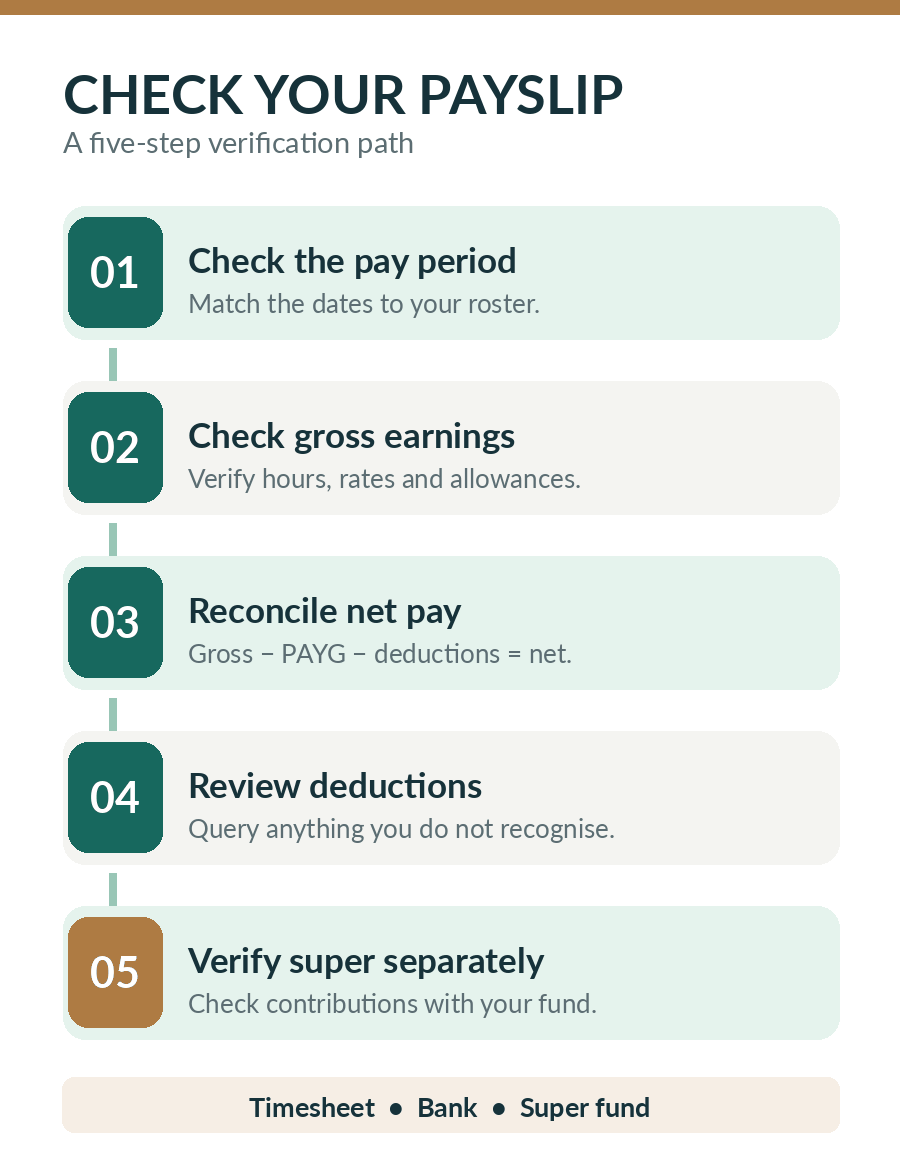
A five-minute payslip check
You do not need to calculate your entire tax return every payday. A short review can help identify problems early.
First: confirm the pay period and payment date. Make sure the payslip covers the shifts and days you expected.
Second: compare the gross earnings with your work records. Check your hours, ordinary rate, overtime, penalty rates and allowances.
Third: reconcile the net amount. Subtract PAYG withholding and applicable employee deductions from gross pay, allowing for any separately recorded adjustments. The result should agree with your net pay.
Fourth: inspect deductions you do not recognise. Ask payroll what the amount relates to and what authorises it.
Fifth: check super separately. Confirm the reported contribution, nominated super fund and actual payments received.
You can retain payslips alongside your timesheets and bank records. This makes it easier to explain a discrepancy when it occurs rather than trying to reconstruct several months of payments later.
What if your payslip does not add up?
A discrepancy does not always indicate deliberate underpayment. A shift may have been allocated to another pay period, a payroll adjustment may be pending, or the record may contain a mistake.
Start by identifying the exact difference.
For example, instead of saying your wages look wrong, explain that you worked six Saturday hours but cannot find the relevant payment on your payslip for that period.
Ask payroll to confirm the hours recorded, the applicable rate and whether any correction is required.
Keep a copy of the payslip, roster and your written enquiry.
If the explanation does not resolve the problem, use the Fair Work Ombudsman’s guidance to check your pay and entitlements or seek appropriate assistance.
What if your employer never gives you a payslip?
Australian employers must generally provide a payslip within one working day of payday, even when an employee is on leave.
Payslips may be electronic or paper-based, but they must contain the required information.
If you do not receive one, request it from your employer and keep a record of that request. If the problem continues, the Fair Work Ombudsman provides guidance on the available next steps.
Make your next payslip easier to understand
Once you recognise the relationship between gross pay, tax withholding, deductions, net pay and employer superannuation, the figures become much easier to follow.
The key is to check each part against the right record.
Your timesheet helps verify earnings. Your bank statement confirms take-home pay. Your super account helps verify employer contributions. ATO records and your annual tax assessment provide another view of the tax information.
Make a habit of checking each payslip while the details are fresh. Finding one missing shift or an unfamiliar deduction early is far simpler than discovering a discrepancy months later.
This article provides general information about Australian payslips, tax withholding, workplace deductions and superannuation. Rules and individual outcomes can vary according to employment arrangements and personal circumstances. Information checked November 2026.