<!doctype html>
Refund Rights for Online Purchases in Australia
You open a parcel and find the wrong product. Or your order never arrives, and the seller keeps asking you to wait. Before accepting store credit or paying to return something, work out why you are asking for a refund.
Australian online shoppers generally have the same consumer protections as people buying in a physical shop. However, a faulty product, a missing delivery and a change of mind can lead to different outcomes. Understanding those differences helps you make a clear request.
Quick Overview
- Buying online does not remove your consumer rights.
- A product with a major problem generally gives you a choice of refund or replacement.
- A minor fault usually gives the seller an opportunity to fix it.
- Change-of-mind returns depend on the seller’s policy.
- Keep the listing, order confirmation, payment records and messages.
- Check payment-provider dispute deadlines while dealing with the seller.
Start with the reason for your return
The phrase “online shopping refund rights Australia” covers several situations. The first step is to describe what actually happened.
| What happened? | What to check first |
|---|---|
| You ordered the wrong size or no longer want the item | The seller’s change-of-mind policy |
| The item is faulty or substantially different from its description | Your consumer guarantee rights |
| The order has not arrived | The promised delivery timeframe and the seller’s explanation |
| You bought through a marketplace | Who sold the item and the platform’s dispute process |
Your order documents will help you identify the seller, what was promised and which process to use.
If you simply changed your mind
Choosing the wrong colour, ordering the wrong size or finding a cheaper price elsewhere does not automatically entitle you to a refund under consumer guarantees.
A retailer may offer additional returns rights. Its policy might require unused goods, attached tags or a return within a stated period. Read the policy before posting anything back, including who pays postage and whether the outcome is a refund, exchange or credit.
For example, imagine you order the size shown in your shopping basket, but it does not fit. That may be a change-of-mind return. If the seller sends a different size from the one you ordered, explain that difference when contacting them. Consumer Affairs Victoria provides further guidance on change-of-mind returns.
If the product has a problem
Consumer guarantees provide basic protections that a store’s returns policy cannot remove. A blanket “no refunds” statement does not settle whether you are entitled to a remedy.
Likewise, a seller generally cannot refuse to help with a consumer guarantee claim simply by sending you to the manufacturer. Start with the business that sold you the product and describe the problem clearly.
For broader background, read our guide to consumer guarantees for faulty products.
When can you choose a refund?
For a major product problem, you can generally choose a refund or replacement. Examples include an unsafe product, one substantially different from its description, or one that cannot perform its normal purpose and cannot easily be fixed within a reasonable time.
For a minor problem, the seller can usually provide a free repair first. If it cannot or will not fix the issue within a reasonable time, further remedies become available.
The business can assess the product before deciding how to respond. Where a refund is due, you do not have to accept store credit instead of repayment in the original payment form unless you agree. The ACCC’s repair, replacement and refund guidance explains these distinctions.
What if your parcel never arrives?
A delayed order needs a different conversation from a faulty item.
Check the delivery estimate, tracking information and any updates about delays. Then ask the seller to confirm where the order is and how it proposes to resolve the problem.
Businesses must provide a solution when they cannot supply a paid order on time or within a reasonable time. However, an unexpected delay does not automatically mean the seller has broken the law. Give it an opportunity to explain and respond.
Keep the discussion specific. “Please explain why my order has not arrived and confirm your proposed solution” is more useful than repeatedly asking for an update without mentioning the missed timeframe. See the ACCC’s guidance on orders that have not been supplied.
Who pays return postage?
For a small faulty item that can easily be posted, you may need to pay the initial return cost. If the fault is confirmed, reasonable postage or transport costs can be recovered from the seller. Keep the receipt.
You do not need the original packaging to return a faulty product, although you should pack it safely. Proof of purchase still matters.
For large goods that would involve significant return costs, ask the seller to arrange collection. The ACCC’s consumer guide explains that the seller is responsible for collecting goods where the cost of returning them is significant.
Agree on the return address and arrangements before sending anything. Photograph the item and retain tracking details so you have a record of its condition and return.
Marketplace and overseas purchases need extra checks
With marketplace purchases, identify the actual seller. Consumer guarantee claims generally go to that seller, while the platform may provide a separate buyer-protection process. Some guarantees do not apply to purchases from private individuals who are not running a business.
Overseas businesses directly supplying Australian consumers must follow Australian Consumer Law, although enforcing your rights can be difficult. Different circumstances, such as using an overseas forwarding address, can affect coverage. Check the ACCC’s online shopping guidance before assuming every international purchase has identical protection.
How to make a clear refund request
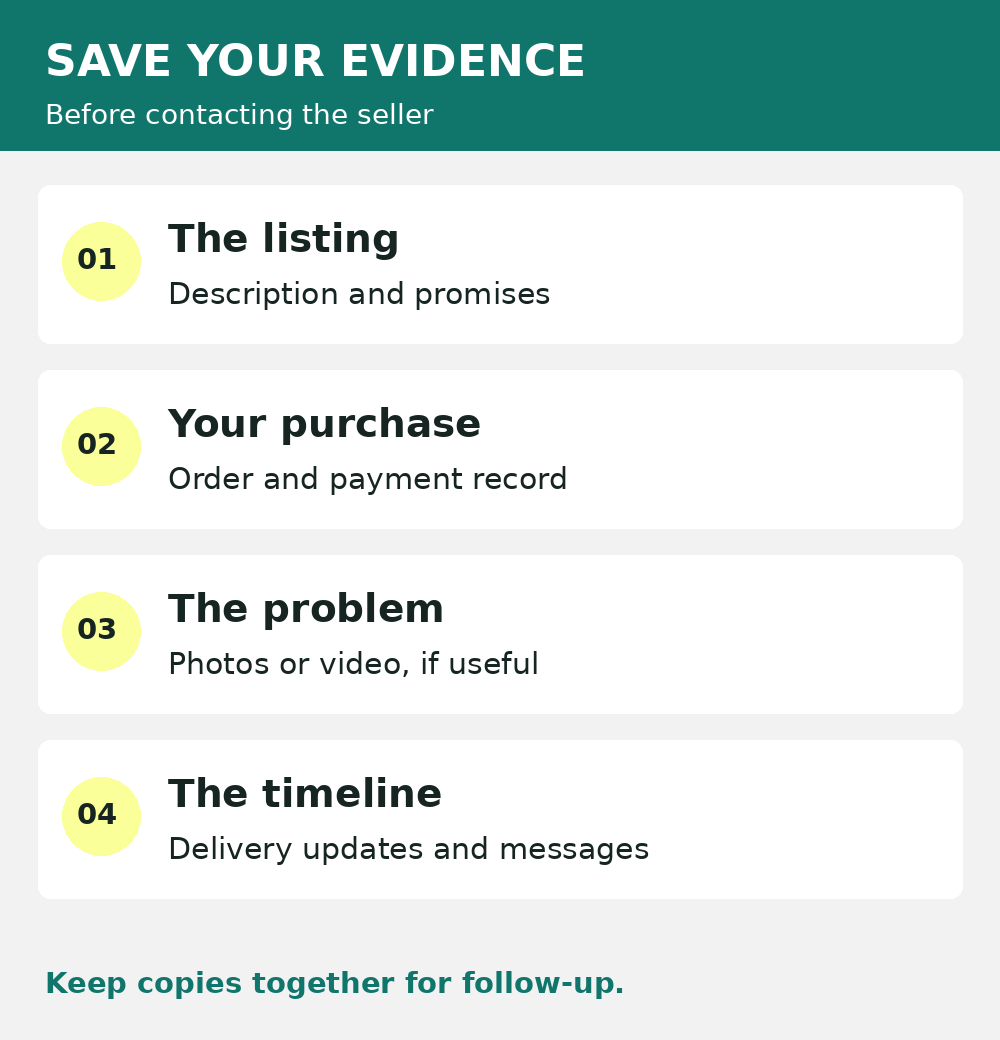
Collect the evidence before contacting customer support:
- Save the product listing and relevant description.
- Find your order number and proof of purchase.
- Photograph or record the problem where useful.
- Write a short timeline of what happened.
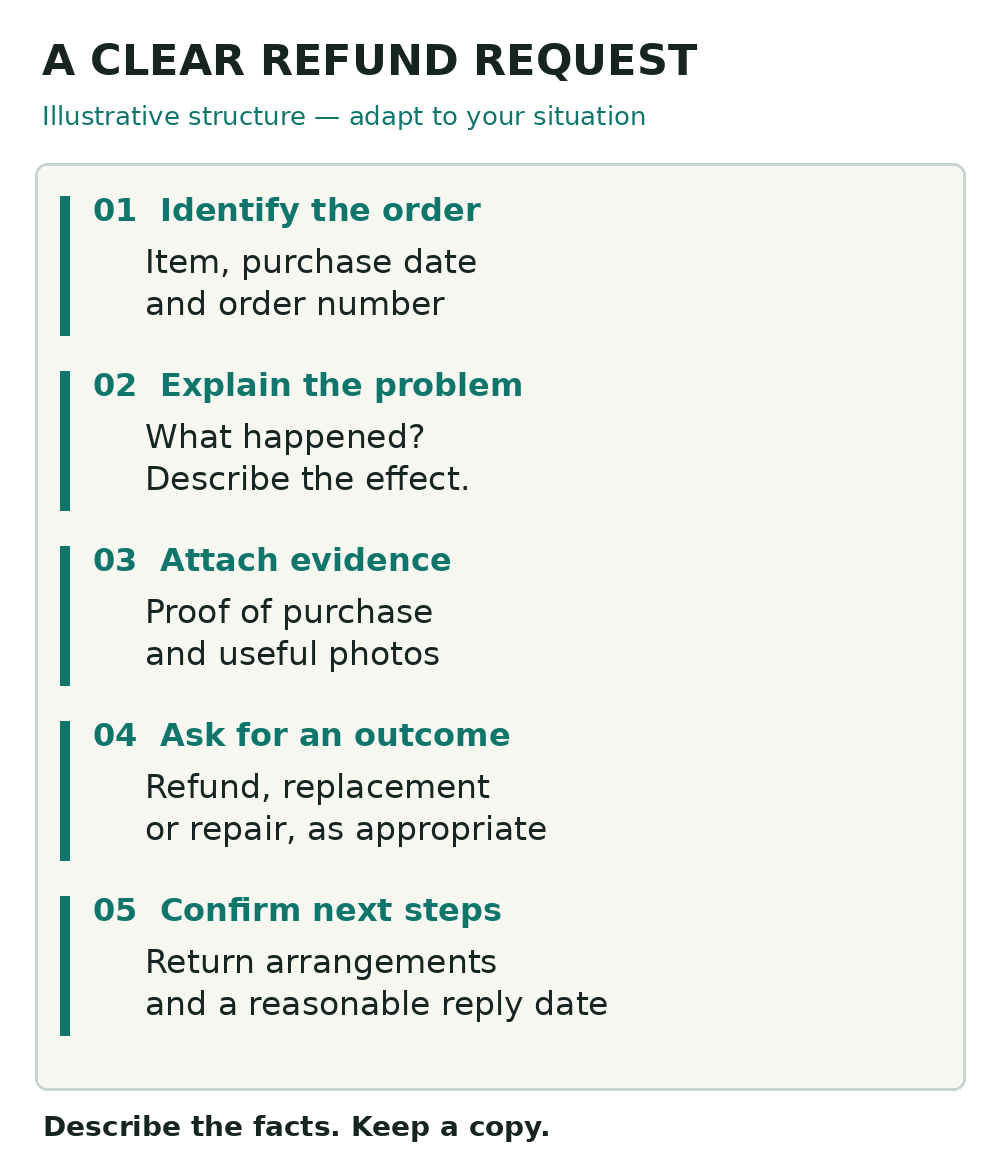
- State the outcome you want and explain why.
Keeping the complaint in writing makes it easier to follow up and show what you have already asked the business to do. The ACCC’s complaint guidance includes advice on approaching a seller.
A first message could say:
I purchased [item] on [date], order number [number]. The problem is [specific description]. I have attached my proof of purchase and supporting photographs. I am requesting [refund, replacement or repair]. Please confirm the next steps, including any return arrangements, by [reasonable date].
Choose the request that fits your circumstances. Avoid describing every fault as a major failure without explaining its effect.
If the seller does not resolve it
You can contact your state or territory consumer affairs or fair trading agency for assistance. If you paid by card, ask your bank promptly whether a chargeback is available. Payment services may also have dispute procedures and deadlines.
A chargeback is subject to eligibility rules and is not a guaranteed refund. Keep your supporting records and check the relevant deadlines while the complaint continues.
You can also report concerning business conduct to the ACCC, but it does not resolve individual refund disputes.
Before you accept the seller’s answer
A useful refund claim starts with a clear explanation: what you ordered, what went wrong and what outcome you are seeking. Keep the evidence together, distinguish a change of mind from a product or delivery problem, and confirm return arrangements before spending money on postage.
If the first response only repeats the store policy, ask the seller to address the specific issue you raised. If the complaint remains unresolved, use the available consumer assistance and payment-dispute processes promptly. Clear records will help whoever reviews the matter understand it.
This article provides general information about ordinary online goods purchases, rather than advice about a particular dispute.