
An employer offers salary packaging, and the estimated tax saving looks appealing. Before signing up, you need to understand where the money goes, what comes out of your pay and whether the arrangement leaves you better off.
Salary packaging in Australia lets you exchange part of your future salary for agreed benefits. Depending on your employer, those benefits might include additional super contributions, a car or certain living expenses. The result depends on the benefit, fees and your personal circumstances.
How salary packaging works
Normally, your employer deducts tax from your salary and pays the remainder into your bank account. You then use that money to cover expenses.
With an effective salary packaging arrangement, you agree to give up some future salary in exchange for your employer providing agreed benefits. Your remaining cash salary is generally subject to income tax.
For example, you might arrange for $100 from each fortnight’s pre-tax salary to go into your super fund. Payroll directs that amount to super and calculates tax on your reduced cash salary.
The agreement needs to exist before you perform the work that earns the salary. You cannot retrospectively package wages you have already earned. Keep the amount, benefits and start date in writing. [1]
What can you salary package?
Your employer’s policy determines what is available. A benefit offered by one workplace may be unavailable or treated differently at another.
| Arrangement | What it involves | Main point to check |
|---|---|---|
| Additional super | Your employer directs some pre-tax salary into your super fund | Contribution limits and access to the money |
| Car packaging | A vehicle arrangement, often involving a novated lease | Total cost, tax treatment and contract obligations |
| Eligible living expenses | Approved expenses paid or reimbursed through an employer’s program | Employer eligibility, permitted expenses and limits |
Some employers receive fringe benefits tax concessions or exemptions that can make packaging more attractive. These arrangements are particularly relevant in parts of the not-for-profit and health sectors, but eligibility depends on the organisation.
Fringe benefits tax, usually shortened to FBT, is a tax employers may pay on benefits provided to employees. Ask whether any FBT cost is included in your package calculation.
Moneysmart’s salary packaging guide explains the broad benefit categories. [2]
Packaging living expenses
If your workplace offers living-expense packaging, ask for its current list of eligible expenses and required evidence. Confirm whether payments go directly to a supplier, reimburse you or use a packaging card.
Also ask which year the limit follows. The FBT year runs from 1 April to 31 March, which differs from the income tax financial year.
Check what happens to unspent funds and outstanding claims when the relevant period ends or you leave the employer. [3]
Packaging a car
Treat a car package as a financial commitment that needs its own comparison.
Ask for the vehicle price, finance charges, administration fees, running-cost assumptions and any payment due at the end. Request an explanation of what happens if you change jobs, take unpaid leave or end the arrangement early.
Compare the quote with the cost of buying and running a suitable car yourself. Use the same vehicle and ownership period for both options. An advertised tax saving alone does not establish which option costs less.
Salary sacrificing into super
Salary sacrifice can help build retirement savings by directing part of your pre-tax pay into super.
These payments count as concessional contributions, alongside compulsory employer contributions and personal contributions for which you claim a tax deduction.
For 2026–27, the general concessional contributions cap is $32,500. It applies across your super funds, rather than separately to each account. Eligible people may also be able to use unused cap amounts from earlier years.
Before setting a contribution amount, include expected employer payments and other concessional contributions. Check the current rules through Moneysmart’s super contributions guide. [4]
Most concessional contributions are taxed at 15% within the fund. Different treatment can apply, including additional tax for some higher-income earners. [5]
Your salary-sacrificed super is additional to your compulsory super guarantee entitlement. Your employer cannot use those sacrificed contributions to replace the compulsory contributions it owes you. [6]
A simplified example
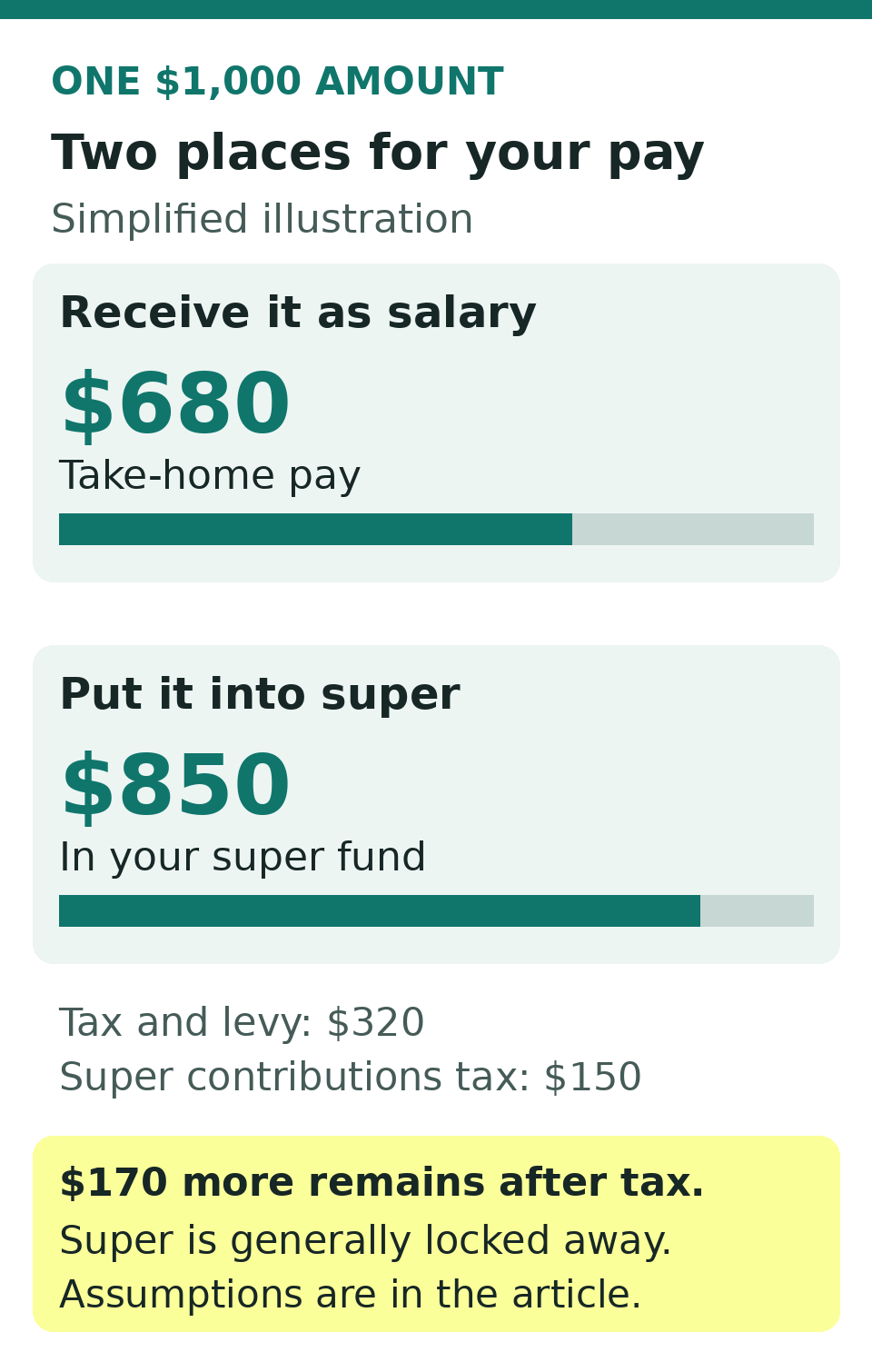
Assume an employee is considering sacrificing $1,000 into super. For this illustration:
- The entire amount would otherwise attract 30% income tax and a 2% Medicare levy.
- The super contribution attracts 15% contributions tax.
- The employee remains within their contribution cap.
- Fees, offsets, additional taxes and other income-test effects are excluded.
| Treatment of the $1,000 | Amount remaining |
|---|---|
| Received as salary after the assumed tax and levy | $680 in take-home pay |
| Salary sacrificed into super after contributions tax | $850 in super |
Under these assumptions, $170 more remains after tax when the money goes into super.
However, the employee has $680 less available for current spending. Super generally remains unavailable until a condition of release is met, such as retirement after the relevant age. The example illustrates a tax difference; it does not predict an individual result. [7]
 However, the employee has $680 less available for current spending. Super generally remains unavailable until a condition of release is met, such as retirement after the relevant age. The example illustrates a tax difference; it does not predict an individual result. [7]
,000 comparison: $680 take-home pay or $850 in super after the assumed taxes.” style=”display:block;width:100%;max-width:100%;height:auto;border:1px solid #d5e0dc;border-radius:8px;”>
Lower taxable income can still affect other calculations
Salary packaging can reduce taxable salary while leaving other income calculations unchanged or increasing them.
Certain benefits appear on your income statement as a reportable fringe benefits amount. This uses a “grossed-up” value, which can be higher than the underlying benefit. You do not pay ordinary income tax on that reported amount, but it can count towards other income tests. [3]
HELP and other study loans
Salary sacrificing into super generally does not reduce the income used to calculate compulsory study-loan repayments, because reportable employer super contributions are included.
Reportable fringe benefits can also increase repayment income. Ask payroll whether additional tax withholding is needed to cover the expected repayment. [8]
Government payments and child support
Services Australia uses adjusted taxable income for several payments and assessments, including Child Care Subsidy, Family Tax Benefit and child support. The calculation depends on the payment or service.
Check the relevant rules before updating an income estimate. A lower taxable salary does not automatically mean a higher entitlement. [9]
What to ask before signing up
Request a written comparison showing your position with and without packaging. It should explain:
- Your pay: How much will reach your bank account each payday?
- Your benefits: What expenses or contributions will the package cover?
- Your costs: What setup, ongoing, transaction or exit fees apply?
- Your reporting: What fringe benefits or super contributions will be reported?
- Your flexibility: What changes if your income, hours or employment changes?
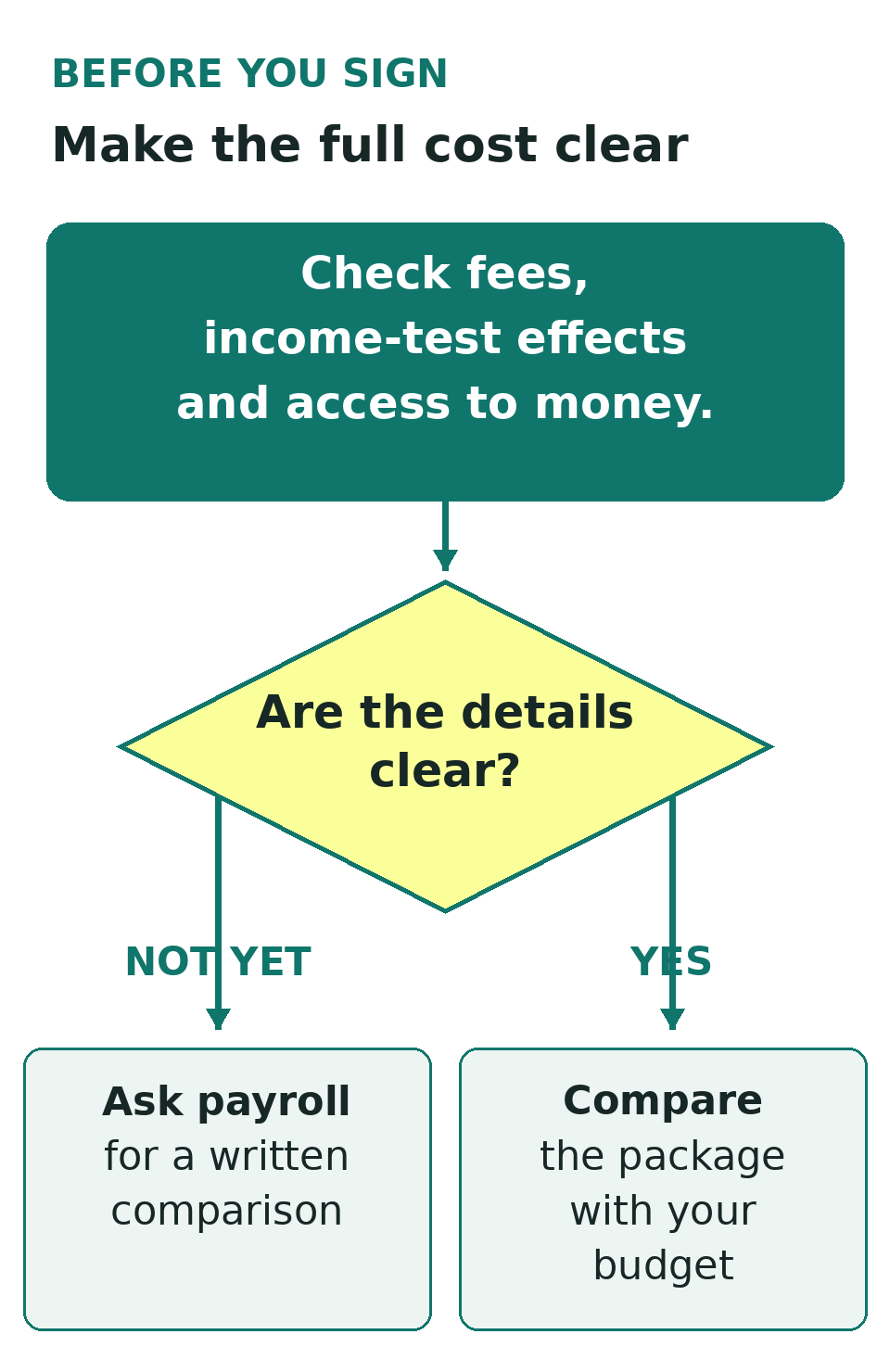
For a living-expense package, compare your remaining cash plus the bills covered. For super, compare the retirement contribution with the reduction in spendable income.
Put the proposed take-home pay into your household budget before committing. The site’s guide to realistic budgeting can help you review regular expenses and savings commitments.
You also cannot claim a personal tax deduction for an expense your employer pays through your salary package. [6]
Deciding whether salary packaging suits you
Start with the benefit you would actually use and the amount you can comfortably commit. Then compare the full arrangement, including fees, reporting effects and access to your money.
An eligible living-expense package may help with bills you already pay. Extra super may support a retirement goal. A car package needs a separate assessment of its purchase and finance costs.
Ask payroll to explain the workplace arrangement, and seek individual tax or financial advice where your circumstances need it. The useful result is a clear picture of what you receive, what you pay and what changes elsewhere in your finances.
General information only. Rules and figures checked on 9 November 2026.