
HOME LOANS · PRACTICAL COMPARISON
A fixed vs variable home loan comparison starts with two priorities: how predictable your repayments need to be, and how much freedom you need to change the loan.
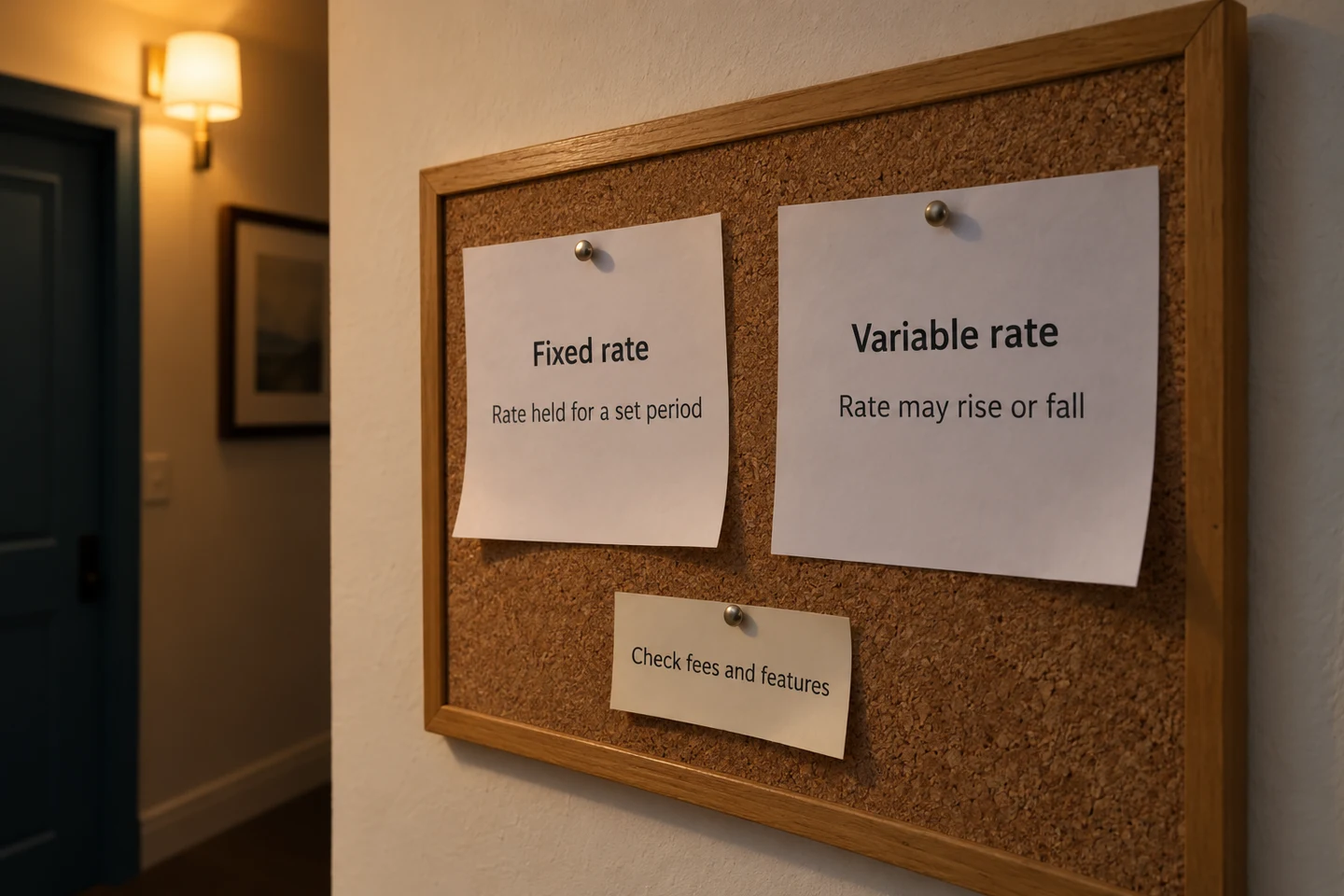
A fixed rate provides certainty for an agreed period. A variable rate can move up or down and often comes with more flexible features. Either can be a poor fit if its restrictions clash with your plans, so compare the actual loan terms alongside the advertised rate.
Look closely at the fixed period, its end date and the cost of leaving early.
Check extra-repayment rules, access to money and the cost of useful features.
Rate certainty versus flexibility
With a fixed-rate home loan, the interest rate stays the same for a set period, commonly one to five years. That can make the scheduled repayments easier to budget for. You are protected from rate rises during that period, but do not receive the benefit of rate falls on the fixed portion.
With a variable-rate loan, the lender can change the rate. Repayments may rise or fall accordingly. The RBA cash rate is influential, but it is not your mortgage rate: the Reserve Bank explains that lending rates do not always move in lockstep with its policy rate.
That makes the decision partly about your ability to absorb a change. Work out how much room remains after repayments, essential spending and other commitments. If a higher payment would leave little margin, that is important information even if you expect rates to fall.
ASIC’s Moneysmart fixed and variable rate guide explains the trade-offs and what happens when a fixed period ends. Usually, the loan moves to a variable revert rate unless you arrange another option.
Features and restrictions
“Fixed” and “variable” describe the rate structure, not every rule attached to the product. Read the features you expect to use and the restrictions you could encounter.
Extra repayments
Ask how much extra you can pay, over what period, and what happens if you exceed that allowance. A fixed loan may cap additional repayments; variable loans often provide more scope. Do not assume all products use the same limit or reset date.
Offset and redraw
An offset is a separate account whose balance reduces the loan amount used to calculate interest. Redraw is access, under the lender’s rules, to extra repayments already made into the loan. Their availability and access conditions vary.
For an offset, compare any higher loan rate or account fee with the benefit of the balance you realistically expect to hold. Moneysmart’s offset guide explains this cost check. A feature you rarely use can be an expense without much practical value.
Leaving or changing the loan
Fixed-rate break costs may apply if you sell, refinance or repay beyond permitted limits before the fixed period ends. The amount is not necessarily a simple flat fee. Westpac’s explanation of break costs illustrates the triggers and why a current estimate matters; your own lender’s contract determines your position.

If a move is plausible, ask the lender for a written explanation of what would happen to the loan. Before acting, request a dated break-cost estimate and check how long it remains valid.
A variable loan can still involve discharge, application or switching fees. Moneysmart’s switching guide also cautions against extending the loan term without considering the extra interest. A lower monthly payment can partly reflect paying the debt back over more years.
Split loans explained
A split loan divides the borrowing into fixed and variable portions. You choose an allocation offered by the lender; it need not be half and half. The fixed part adds repayment certainty, while the variable part retains exposure to rate changes and may provide flexible features.
Check each portion’s rate, fees and repayment rules separately. If an offset is available, confirm which portion it is linked to. A split arrangement does not remove the restrictions attached to the fixed part. This lender’s explanation of loan types describes how the two portions work together.
A $600,000 illustration
Imagine borrowing $600,000, with $360,000 fixed and $240,000 variable. This is an illustration, not a suggested allocation.
For a simple sensitivity check, assume a 30-year remaining term, monthly principal-and-interest repayments, no fees or offset, and a 6% annual rate on every portion initially. Now compare the same balances and remaining terms with only the variable rate changed to 7%.
| Hypothetical rate setting | 60% fixed / 40% variable | Fully variable |
|---|---|---|
| All portions at 6% | $3,597 | $3,597 |
| Fixed stays 6%; variable is 7% | $3,755 | $3,992 |
| Monthly increase | About $158 | About $395 |
Calculated using a standard monthly amortisation formula and rounded to the nearest dollar. These are hypothetical rates, not current offers or a forecast. Actual lender calculations, fees and repayment arrangements may differ.
The example shows how fixing part of the balance reduces exposure to a variable-rate rise. If variable rates fall, only the variable portion receives that benefit during the fixed period. It does not establish which structure will cost less over time.
The allocation should also leave room for your expected use of extra repayments and cash balances. Ask whether the variable portion is large enough for those plans, and what happens if you later want to change the split.
Questions before choosing
Take these questions to the lender or broker and ask for answers you can keep with the quote:
- How much repayment movement can my budget absorb? Test higher and lower rates, plus a period with less income or higher essential spending.
- Could I sell, refinance or make a large repayment during the fixed period? Ask which costs and limits those events could trigger.
- What cash will I actually keep available? Check access rules and whether an offset or redraw facility fits how you manage money.
- What happens when the fixed period ends? Ask about the revert rate, review timing and the process for choosing another option.
- What are the total fees across the structure? Include establishment and ongoing charges, feature costs and any separate charges on split portions.
- Are the quotes using comparable assumptions? Use the same borrowing amount, remaining term, repayment type and frequency.
Use the Moneysmart mortgage calculator to explore repayment changes. Calculator results are estimates; use the lender’s written schedule and conditions to assess the actual offer.
What should I request with each quote?
Ask for a Key Facts Sheet where applicable, a repayment schedule and the relevant product conditions. Moneysmart’s home-loan comparison guide explains how consistent inputs help you compare costs and features.
A comparison rate combines interest with most fees, using stated assumptions. It is useful alongside the detailed quote, but does not capture every possible cost or tell you whether access restrictions suit your plans.
Choose the trade-offs you can live with: a manageable repayment range, features you will use, and a clear understanding of what changing plans could cost. Revisit the choice when your circumstances or a fixed-period end date approaches.
General information for Australian readers, checked 26 October 2026. This article does not recommend a lender, rate or loan structure for your personal circumstances. Check current product terms and obtain advice suited to your situation.